The “Why” — What is the real problem?
Most people plan their day without any awareness of how their body will actually feel at the time they’ve scheduled something. A meeting booked for 2pm on a Tuesday sounds neutral on paper, but if your circadian rhythm produces a deep post-lunch trough at that hour, you will show up for it distracted and underperforming — and you will have no idea that moving it to 10am would have made it twice as productive.
The data to predict this already exists. It is sitting in your sleep log, your meals, your stress levels, and your own historical snapshots of how you felt at specific times of day. The problem is that nothing puts this data onto your calendar so you can see it alongside your schedule.
There are three distinct pain points this app addresses:
1. “I don’t know when to do my best work.” Most people have a rough intuition — “I’m a morning person” — but no data. They book important tasks randomly across the day and wonder why some sessions feel sharp while others feel like dragging through mud.
2. “I know I slept badly, but I have no idea how much it matters today.” Seven hours of sleep at poor quality is measurably different from eight hours at high quality — but your calendar looks exactly the same either way. You need the physiological reality to be visible on the schedule.
3. “I want to eat well and exercise, but I don’t know when those choices land hardest.” A heavy lunch at 12:30pm will create a 1.5-hour performance dip. Eating it at 1:30pm instead — after your 1pm meeting — means the dip lands in an empty slot rather than on top of your next task. Tiny decisions compound, but only if you can see the consequences.
Who is this for?
- Knowledge workers with flexible schedules Developers, designers, writers, analysts — anyone whose output depends on cognitive state rather than physical presence. These are people who can move meetings and task blocks around but currently lack a signal for when to do so.
- Students A student who knows their peak hours can schedule exam prep during those windows and leave administrative work (email, reading notes) for the troughs. The energy curve is especially pronounced in students due to irregular sleep patterns.
- People managing a health condition affecting energy Chronic fatigue, post-viral conditions, thyroid issues, ADHD — many conditions affect energy in patterns. Logging and visualising those patterns helps people understand and plan around them rather than fighting them blindly.
- Anyone who has tried to “be more productive” and gotten frustrated Most productivity tools focus on what to do and when (task managers, time-blocking). Very few address the physiological dimension of how well you will be able to do it. MyCalendone is the layer that fills that gap.
Why would someone log data every day?
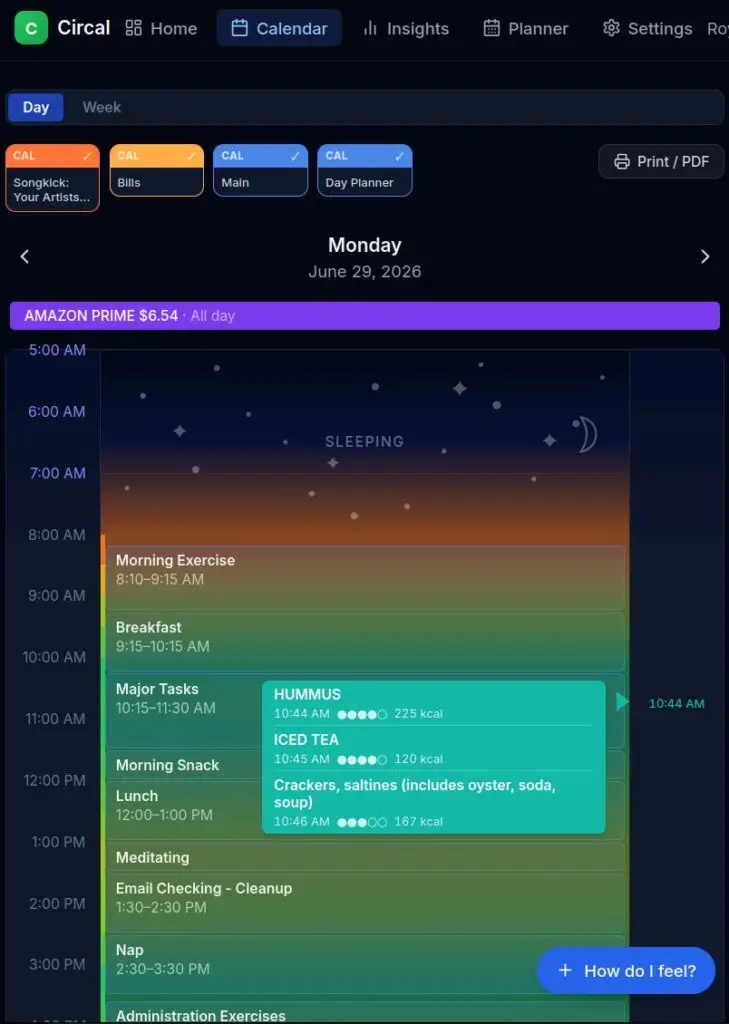
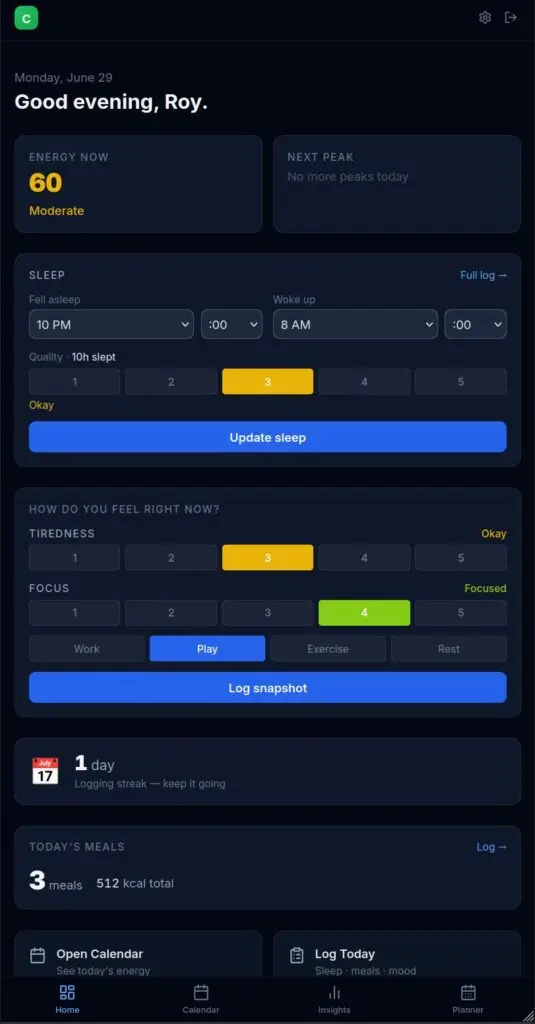
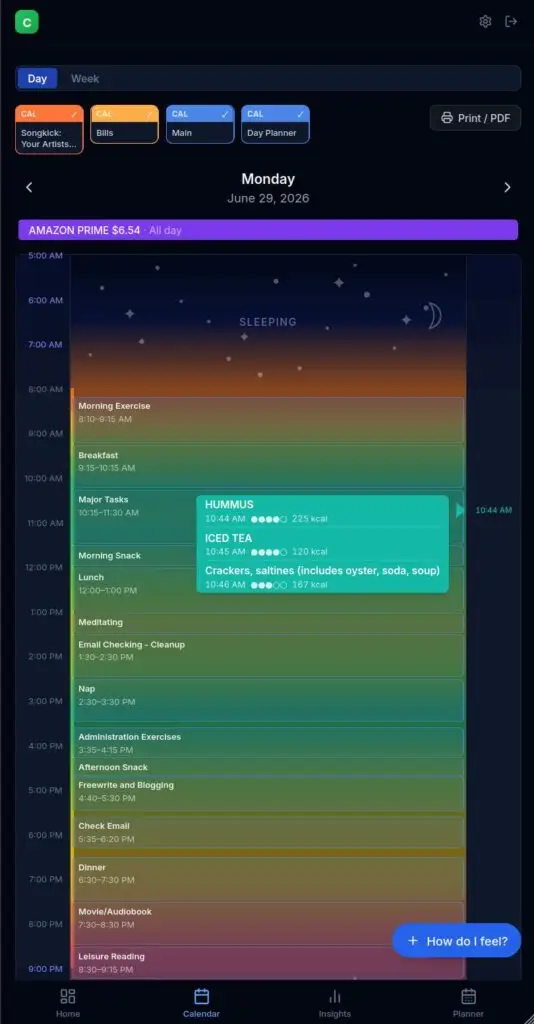
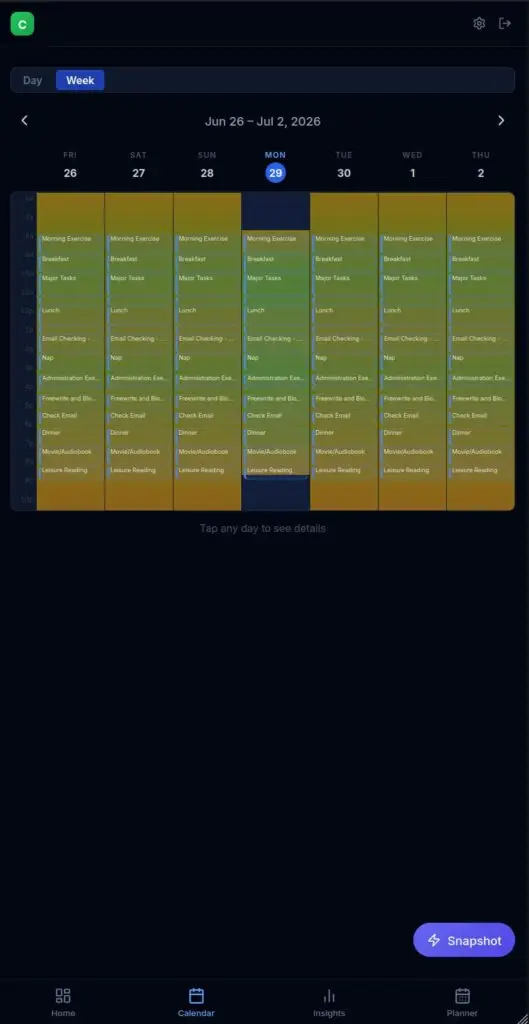
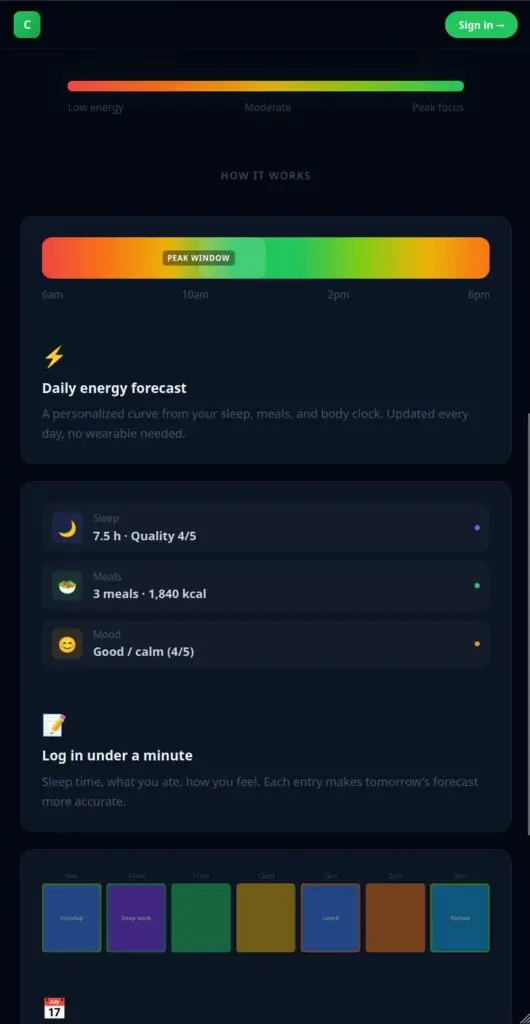
The hook for daily use is the calendar. The calendar is always useful — even with no logged data, the circadian curve gives you a baseline energy overlay. Every piece of data you log makes the predictions sharper:
- Log sleep: the curve shifts to start at your actual wake time, sleep inertia applies, and the consistency bonus/penalty engages.
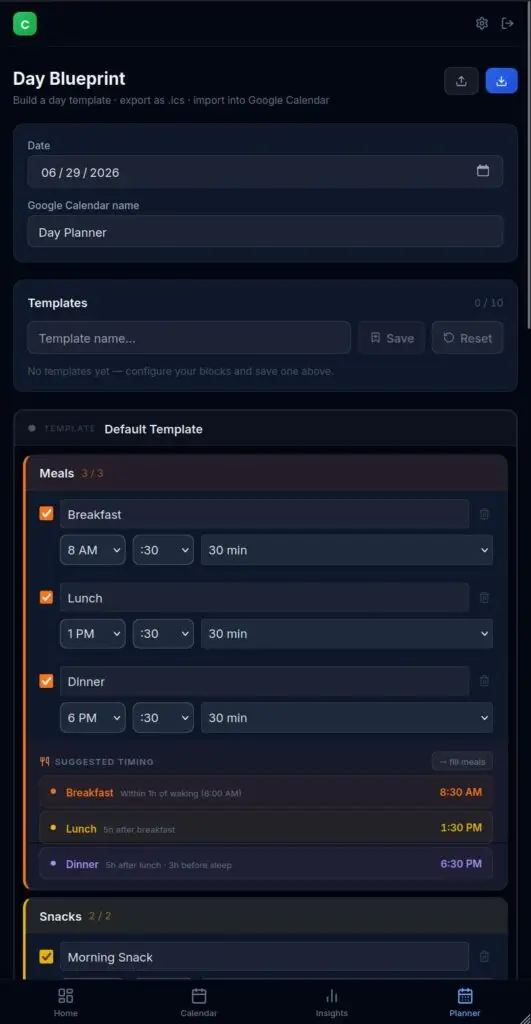
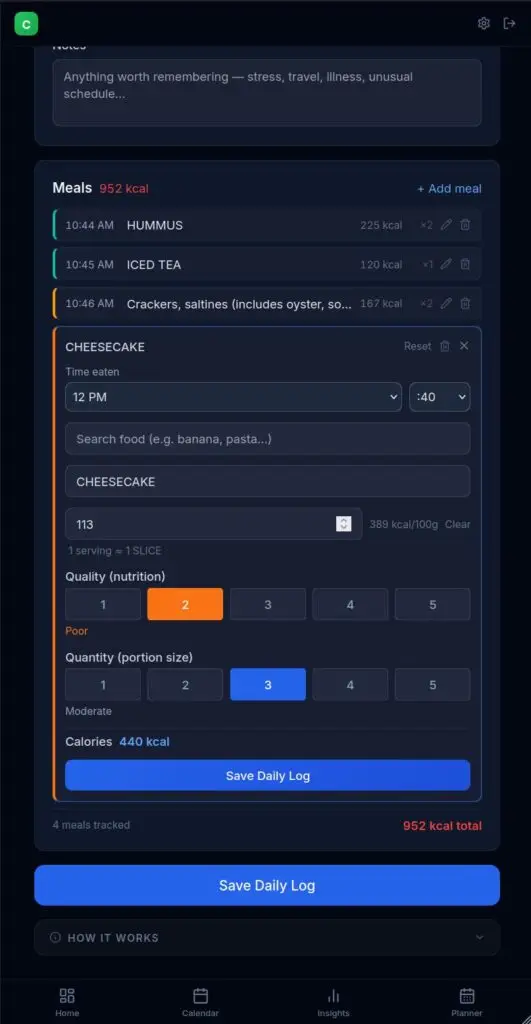
- Log meals: digestion dips appear in real time. The 2pm orange block is no longer mysterious.
- Log mood: the flat mood modifier colours the whole day appropriately — on a stressed day, the entire curve drops.
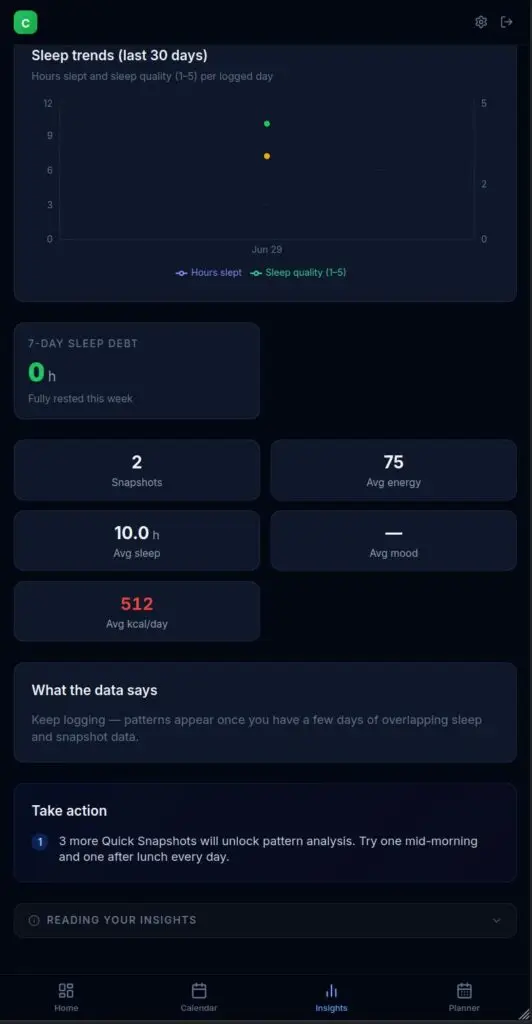
- Log quick snapshots: the historical score learns your personal pattern, week over week, diverging from the generic circadian table toward something that actually matches you.
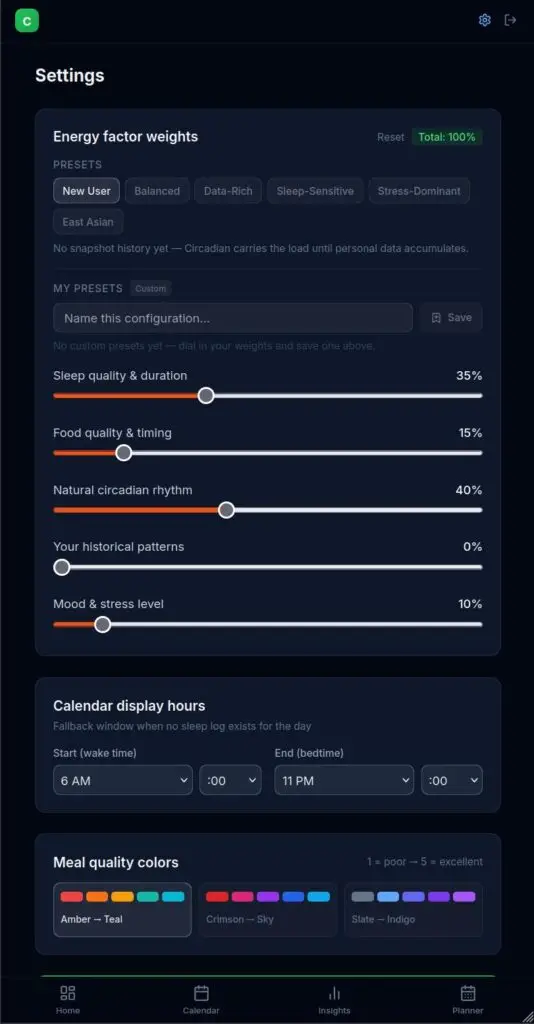
The progression from “generic curve” to “personal energy portrait” is the long-term retention mechanism. The more you log, the more accurate the prediction — and the more the app becomes genuinely irreplaceable to that user.
What makes this different from existing tools?
| Tool | What it does | What it lacks |
|---|---|---|
| RISE | Circadian energy curve + sleep debt | No calendar overlay; no food/mood; no personal history |
| Oura / WHOOP | Biometric readiness score from wearable hardware | Requires $200–$300 device; no calendar event overlay |
| Reclaim.ai / Motion | AI calendar scheduling and task placement | No physiological inputs; schedules tasks but can’t predict energy |
| Exist.io | Correlates mood, sleep, steps retrospectively | Retrospective analytics only; not a forward-looking calendar tool |
| Google Calendar | The calendar itself | No awareness of your physical or cognitive state |
The gap MyCalendone occupies: a tool that reads your health data and puts it on your calendar and improves from your own history — without requiring wearable hardware, a subscription service, or handing your biometric data to a third party.
What this app is not trying to be
- A wearable replacement. Without heart rate, HRV, and skin temperature data, the predictions are less precise than Oura or WHOOP. The goal is “useful signal from data you already have” rather than clinical biometric accuracy.
- A task manager. There are no to-do lists, no project tracking, no deadlines. The app tells you when; what you do with that is up to you.
- A health tracker. Calories and sleep hours are logged as inputs to the energy model, not as goals to hit. There are no rings to close, no daily streaks with social pressure, no gamification.
- A subscription SaaS product (currently). This is a personal tool built for one user’s needs, deployable locally or on a personal Vercel instance. The codebase is designed to be reproduced, understood, and modified.
The sharpest version of the pitch
You already have a calendar. You already have a body. MyCalendone connects the two.