Spoiler warning: this article discusses the whole plot of 12 Monkeys, including the ending.
Some films leave you with a plot. 12 Monkeys leaves you with a question. I put together a short narrated montage of scenes from it, with my own cover of Augustana’s “Boston”, and this is the longer version of what I wanted to say: the film’s strangest rule is that you cannot change the past, and yet everyone in it keeps trying to choose well.
A film that begins with its ending
The first thing you see is a little boy at an airport, watching a man die. He does not know yet that the man is him. Everything that follows is a long walk toward that moment, and the film trusts you to notice.
That is the trick at the center of the story. In the year 2035, survivors of a virus live underground. A prisoner named James Cole is offered a shorter sentence if he will travel back and gather information about how the plague began. The scientists hope his findings will help stop the pandemic that pushed humanity underground. Cole himself is blunter: it already happened, and all he can do is look and report.
Which came first, the egg or the chicken?
That is the question I kept coming back to. Cole is haunted by a recurring dream: an airport, a man being shot, and a woman looking intensely at the child who sees it. As he grows up, he is haunted by the beautiful face of that woman, too.
Only at the end does he understand what the dream is. It is not a dream but a memory. The man who was shot is Cole himself as an adult, the time traveler and researcher, and the woman is someone he will meet when he travels back in time and fall in love with. Imagine seeing your own death and being haunted by it as you grow old, but never knowing it was you until it was too late. The cycle continues endlessly.
Even the middle of the film asks the same thing. In the past, Cole is taken to a mental institution, and his interactions with the people there may have caused more havoc than solution. Or did they? Did he change anything, or was every step he took already part of the story?
Terry Gilliam, the American-born member of Monty Python who went on to direct Brazil, made 12 Monkeys in 1995 from a screenplay by David and Janet Peoples. It was inspired by La Jetée, a 1962 short film by Chris Marker that tells a time-travel story almost entirely through still photographs. Gilliam gives the same idea a crowded, tilted, slightly feverish look, so the world feels as unstable as the mind of the man moving through it.
The cast is famous for Brad Pitt’s wild turn as Jeffrey Goines, which earned him an Oscar nomination and a Golden Globe. But the film’s heart belongs to its two leads.
The director and the machine
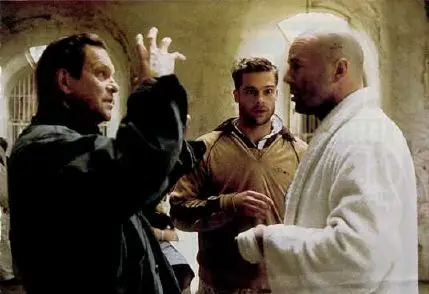
Bruce Willis: the power of doing less
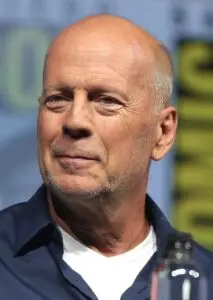
Willis was already a huge action star, which is why his performance here is so striking. James Cole is bruised, confused and often silent. He does not make speeches. He looks at ordinary things, a TV, a shop window, a crowd, as if he is seeing them for the first time, because in a way he is. Willis lets stillness do the work, and it makes Cole more human, not less.
Madeleine Stowe: the doctor who lets doubt in
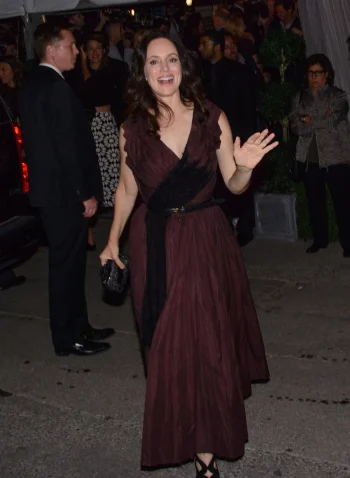
Madeleine Stowe plays Dr. Kathryn Railly, a psychiatrist. Her whole job is to explain things away: a patient says something impossible, and she finds the diagnosis. What makes Railly special is that she notices a feeling she cannot file. She has the strange sense that she has seen this man before, and she is honest enough to hold back her verdict.
Watch how Stowe plays that doubt. She never announces the moment Railly changes her mind. It happens in small looks, in the way she keeps listening after she should have stopped. By the time she and Cole are in a roadside motel, fear has become curiosity, and curiosity has become trust. If you know her as Cora in The Last of the Mohicans, it is the same gift: courage that looks like stillness. (I wrote about that film here.)
The conversation the whole film hangs on
Early on, Railly asks Cole if he plans to save them. His answer is a quiet shock. Everything he is describing has already happened, he says, and all he can do is gather information. Then she pushes: does he think 1996 is the present? No, he says. For him, 1996 is the past too.
To Cole, the whole world is history. To the doctors, that sounds like a delusion. This is the trap the film sets: the truth, said plainly, reads as madness, and the people who should be listening are trained to hear a symptom instead of a warning.
Later the roles seem to reverse. Railly starts to believe the man she was supposed to be treating, and Cole starts to doubt himself. He wonders whether he invented the whole thing and whether everything they say and do has already been decided. It is a small, quiet scene, and it holds the film’s biggest question.
If nothing can change, why choose?
Here is the answer I take from it. The film never tells you whether the future can be changed. What it shows instead is two people who act as if their choices matter anyway. They are kind to each other before they know whether it changes anything. They make a small, human plan: tickets to Key West, a few quiet days. They step toward the ending they already understand, still hoping it might be different.
That is the opposite of autopilot. Cole spends the whole film choosing on purpose, under the worst conditions imaginable: no control over the outcome, no proof that anything he does will count. Three things I take from that:
- Do the next right thing even when you cannot control the result. The outcome may be fixed. Your conduct is not.
- Listen before you diagnose. Railly’s doubt is the most generous thing in the film. She hears him out before she files him away.
- Make small plans with the people you love. The Key West plan is tiny, and it is the most human thing in the story.
The ending hurts because we know where it goes. A gun is raised at the airport, Cole falls, and across the terminal a boy watches, the same boy we met in the first minute. He will grow up carrying that image. Whether he could ever have changed it is the question the film leaves with you. What is not in doubt is that Cole and Railly chose each other on purpose, and that choice is the one thing the film leaves free.
About my video
The video is a short montage of scenes from the film with my own narration over it. I wrote the commentary and recorded it with an AI version of my own voice. The song in the mix is a cover I recorded of “Boston” by Augustana.
Thank you to Terry Gilliam and the Peoples for the film, to Bruce Willis and Madeleine Stowe for making Cole and Railly feel real, and to everyone who worked on it. If you have not seen 12 Monkeys in years, it is worth a rewatch. And if this idea of choosing on purpose appeals to you, browse the Deliberate Execution archive.
12 Monkeys (1995) belongs to its creators and rights holders (released by Universal Pictures). The song “Boston” is originally by Augustana and covered by me. This article and the accompanying video are an independent fan tribute and commentary, with narration added by me. Voiceover created with my own cloned voice.