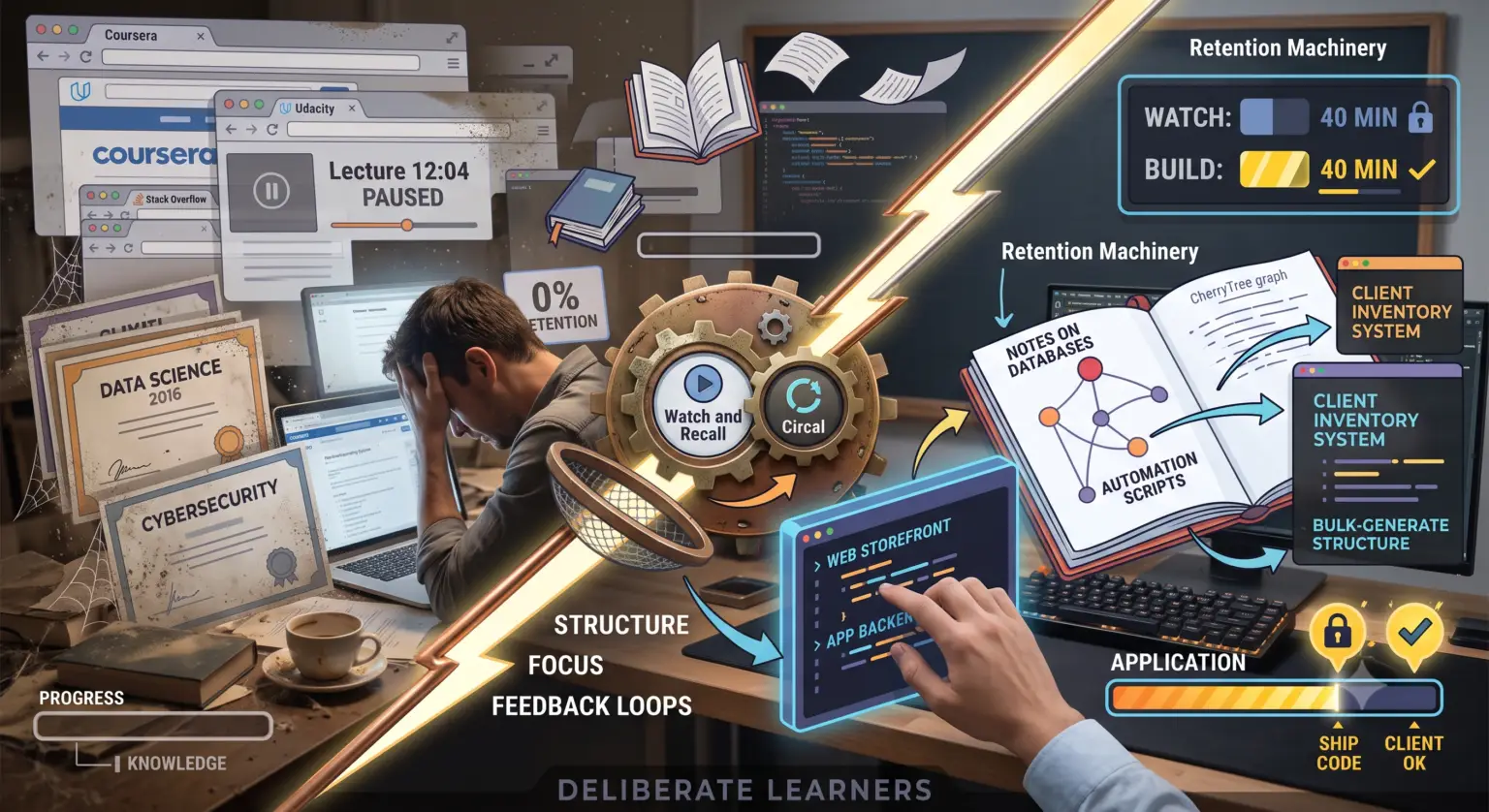
For a stretch of years, I was running two lives at once.
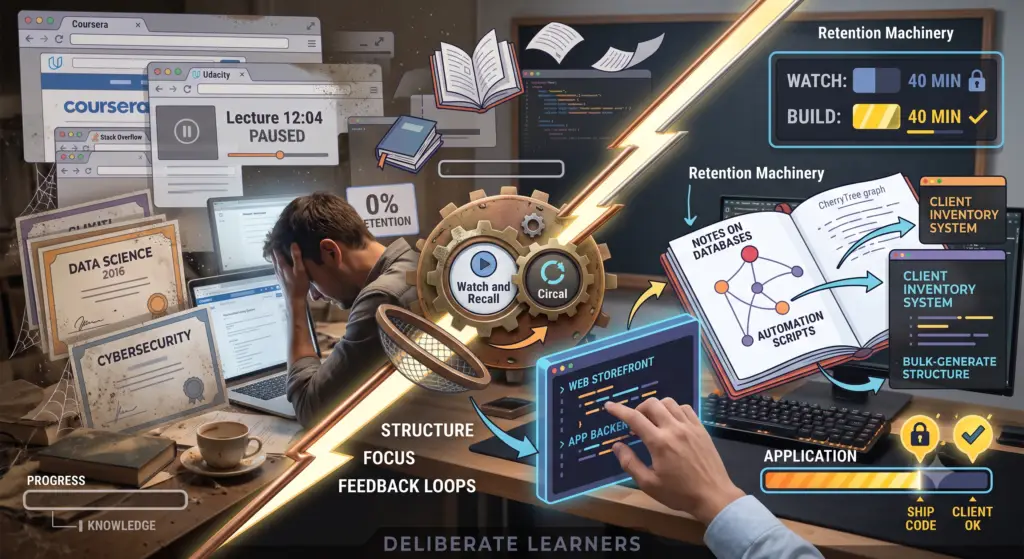
In one, I was an independent IT consultant — building web storefronts, small mobile apps, and social media strategies for local businesses, then teaching those clients how to actually run the tools once I handed them over. In the other, I was a student of everything. Coursera tabs. Udacity nanodegrees. A half-watched lecture paused at 12:04 for three weeks. A specialization I’d paid for and opened twice.
If you’ve read the front page of this site, you already know what I’m describing. The digital graveyard. The feeling of being productive because you’re consuming educational content, while almost none of it sticks. I didn’t write that description from the outside. I wrote it because I lived it — I was the exact person Deliberate Learners is now built for.
This is the story of how the consulting work quietly cured the MOOC problem, and how that cure became a whole site.
The two-life trap
Here’s the thing nobody tells you about learning while you work: the work is the part that’s real, and the learning is the part that lies to you.
Client work has a brutal, honest feedback loop. The storefront either takes a payment or it doesn’t. The client either understands the workflow you built or they call you at 9 pm because they don’t. There’s no faking completion. You ship, and reality grades you immediately.
A MOOC has none of that by default. You can finish a course, collect the certificate, feel accomplished — and retain almost nothing, because nothing forced you to use it. The progress bar is not a feedback loop. It’s a dopamine drip dressed up as growth.
For a while I treated these as separate activities. Consulting was work; MOOCs were self-improvement. It took me longer than I’d like to admit to notice that the courses only ever stuck when they collided with a client problem.
What the work taught the learning
The pattern became obvious once I saw it. A course on databases meant nothing until a client’s inventory system needed one. A scripting technique stayed abstract until I automated something tedious in my own practice. The knowledge that survived was always the knowledge I’d been forced to apply within a week or two of learning it.
So I started reversing the order deliberately. Instead of learning broadly and hoping something would be useful someday, I let the consulting work — and my own projects — generate the demand, and I studied into that demand.
That’s when I began building the systems that Deliberate Learners is really about. Not motivational systems. Retention machinery.
- I built my own sandbox machines — development boxes for programming and testing where new techniques had a place to land immediately, not “eventually.”
- I wrote bash, Python, and batch scripts to bulk-generate the structure of my note system, auto-creating categorized nodes in CherryTree so that every subject I studied had a home before I started, not after I’d already lost the notes.
- I stacked inputs on purpose: audiobooks, text-to-speech extensions, transcripts and captions pulled straight into my notes — because the goal was never to consume a lecture, it was to convert it into something I’d revisit and reuse.
- I practiced the boring fundamentals, down to typing speed, so the friction between “I have an idea” and “it’s on the screen” stayed as low as possible.
None of this is glamorous. That’s the point. Deliberate learning isn’t a mindset poster. It’s plumbing.
The arc hidden in my own certificates
I can see the whole lesson in my own record, and it’s a little embarrassing.
My first real MOOC credential was a Data Science specialization back in 2016. One certificate. Then a long, quiet gap.
The next real cluster didn’t come until 2022 through 2024 — and when it came, it came fast and focused: machine learning, the math underneath it, DevOps and data engineering, and then a run of security programs — IBM’s Cybersecurity Analyst track, security analyst fundamentals, advanced Python scripting for cybersecurity, an enterprise security nanodegree.
Same person. Same platforms. Wildly different result. The difference between 2016 and 2022 wasn’t intelligence or free time. It was method. The early attempt was passive consumption — learning because learning felt good. The later run was deliberate — every course pointed at a real thing I was building, with a system waiting to catch what I learned. The credentials from that second period didn’t just accumulate; they compounded, because each one had somewhere to go.
That contrast is the entire thesis of this site, and I didn’t invent it in a strategy meeting. I found it in my own transcript.
Why this became Deliberate Learners
At some point, the realization stopped being personal and started being a framework I wanted to name.
We are, as the homepage says, drowning in information but starving for wisdom. The tools to learn anything are free and infinite. The bottleneck was never access — it’s intention. Structure, focus, and feedback loops. Auditing your digital diet the way you’d audit a client’s messy workflow before rebuilding it. Turning passive consumption into a high-yield engine.
I’d spent years accidentally proving that consulting — with its unforgiving feedback loops — was what made my learning real. Deliberate Learners is the attempt to give people those feedback loops on purpose, without needing a client emergency to force the issue.
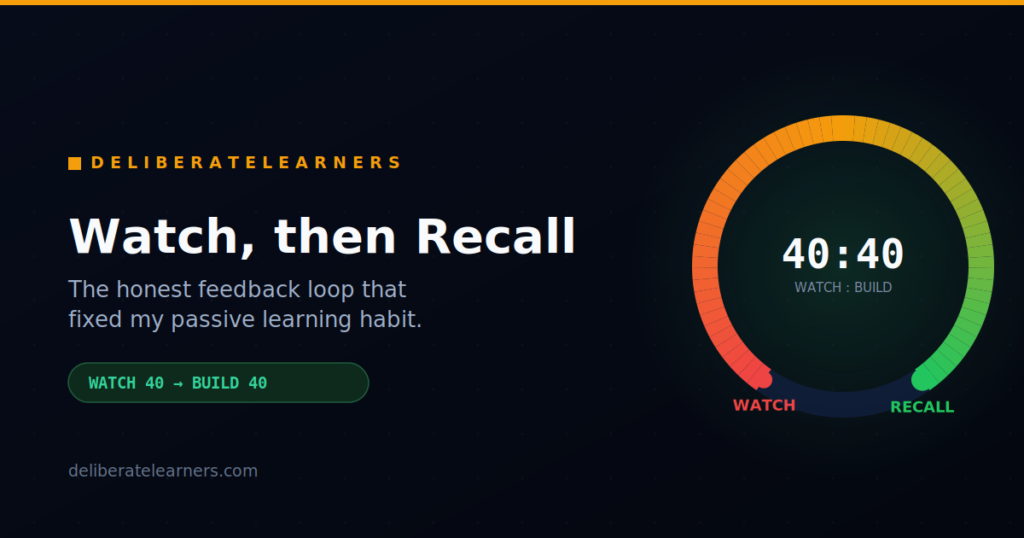
So the first tool I built here is the lesson itself, turned into software. It’s called Watch and Recall, and its rule is the whole argument of this essay compressed into one mechanic: you’re not allowed to just watch. Track the time you spend consuming — a lecture, a tutorial, an article — and the tool locks you into an equal stretch of producing before the session counts. Watch forty minutes, build forty minutes. No skipping ahead, no pausing your way out of the earned time. That constraint isn’t a feature; it’s the client feedback loop I used to get for free, rebuilt for people who don’t have a paying client standing over their shoulder.
It even carries a piece of my other work in it: the way the timer shifts color to let you feel the pressure instead of just reading a number came straight from Circal, a separate tool of mine that uses color to represent energy through the day. Ideas migrate. That’s what happens when you keep a real notebook.
I was the digital graveyard. Then I learned to build the machinery that keeps knowledge alive — and the first piece of that machinery is sitting on this site, waiting for you to be honest about how much of what you “learned” today you actually used.
This is part of the story behind everything I build — the full backstage notebook lives at nostradmsx.com. If the essay landed, try the tool that enforces it: Watch and Recall. And the color mechanic inside it came from Circal, where the same idea tracks your energy instead of your study time.