Category: Engineering

Notes that aren’t tied to a single product — the tooling, process, and engineering decisions that carry across everything I build.

Some of this is workflow: how I run Claude Code sessions, what actually persists between them, which parts of a build belong in version control versus in my head. Some is practice: treating security as a design constraint rather than a pre-launch checklist, and picking up iOS development again after years focused on the web.

These entries tend to be the ones I write after something broke, which makes them more useful than the ones written while everything was working.

SEO: Search Engine Optimization

If you just launched a WordPress site — or inherited one that’s never been properly configured for search — this guide walks through every step needed to get Google to find it, understand it, and rank it fairly. It’s written as a checklist you can work through top to bottom, but each item includes the *why*, the *how*, and the mistakes that trip people up.

This is the general-purpose version of the playbook. It assumes a WordPress site with Yoast SEO installed, but the underlying principles (canonical URLs, verified ownership, a clean sitemap, and healthy Core Web Vitals) apply to any CMS on any host.

Read More »

Security as Part of the Development Process

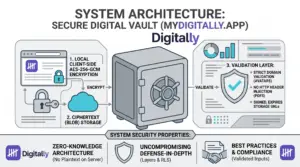
The Big Picture: What Just Launched? A new Encrypted Credential Vault has been successfully pushed to the project. Think of this like a mini-1Password or Bitwarden built right into the app. When you view an asset, you can now securely attach passwords, API keys, or private notes to it. Before this code went live, the latest updates from other teammates (the Friends feature, security docs, and styling tweaks) were safely pulled in and combined with it. Zero-Knowledge Security: How It Keeps Data Safe The core philosophy here is “Zero-Knowledge.” The server (and anyone running the database) has absolutely no idea what your passwords are. Here is exactly how that works in plain English: The Golden Rule: Because the server never stores your passphrase, there is no “Forgot Password” button. If you lose your master passphrase, the data is permanently lost. Building a Digital Vault: How We Engineered Security into MyDigitally.app

Read More »

From Web to iOS: Rediscovering Mobile Development After Years Away

Can an Old Developer Learn New Tricks? Rediscovering Mobile Development for 2026 Can an experienced developer still learn new tricks? That’s the question I found myself asking as I looked at the shifting digital landscape and decided it was time to dive back into the mobile world—this time with a modern, security-first mindset. After years focused on web development and building secure full-stack applications, I am stepping out of the comfort zone of a single stack to embrace continuous learning as a core survival strategy. The spark for this transition came directly from real-world market demands. Clients don’t just want responsive web platforms; they want true native mobile experiences that deliver seamless performance, intuitive workflows, and ironclad data privacy. In an industry where paradigms shift overnight, the willingness to adapt determines who thrives and who gets left behind. Rebuilding the Archives: Three Ecosystems, One Goal This year, in 2026, I

Read More »
Statistical data showing the importance of cybersecurity for businesses

Cybersecurity for Businesses: The Ultimate Guide to Digital Survival

The Stark Reality of Cyber Threats Every 39 seconds, a cyberattack occurs somewhere in the world. This means that while you’re reading this article, organizations and individuals are falling victim to cybercriminals who operate with increasing sophistication and a decreasing fear of consequences. For Business Owners: Your Digital Survival Depends on It Financial Impact Beyond Recovery Small and medium businesses incur an average cost of $2.98 million per data breach, and 60% of small companies go out of business within six months of a cyberattack. These figures cover regulatory fines, legal fees, customer compensation, business interruption, and the cost of rebuilding a reputation. Consider the ransomware attack that shut down the Colonial Pipeline in 2021, disrupting fuel supplies across the Eastern United States. The company paid $4.4 million in ransom, but the true cost included operational losses, emergency response expenses, and long-term reputational damage that continues to affect their business

Read More »

Why Cybersecurity is Mandatory for Personal Websites and Social Media Accounts

In today’s interconnected digital landscape, personal websites and social media accounts have become extensions of our identity, repositories of our memories, and gateways to our professional and personal networks. Yet many individuals treat these digital assets with far less security consideration than they would their physical homes or financial accounts. This casual approach to cybersecurity can have devastating consequences that ripple through every aspect of one’s life. The Reality of Digital Threats Cybercriminals don’t discriminate based on fame or fortune. Personal websites and social media accounts present attractive targets because they often contain a wealth of personal information while frequently lacking robust security measures. Hackers exploit these vulnerabilities not just for immediate financial gain, but to build comprehensive profiles for identity theft, social engineering attacks, and long-term fraud schemes. The threat landscape has evolved significantly over the past decade. What once required sophisticated technical knowledge can now be accomplished with

Read More »

A Practical Guide to Password Managers

In today’s digital landscape, the average person manages over 100 online accounts, from social media platforms to business applications. Yet most people still rely on weak, reused passwords that put their personal and professional lives at risk. If you’re still using “password123” or your pet’s name followed by your birth year, it’s time for a serious security upgrade. Password managers have evolved from nice-to-have tools to essential security infrastructure for both individual users and businesses. They’re your digital vault, your security guard, and your personal assistant all rolled into one powerful application. Why Password Managers Are Essential The Password Problem: The human brain simply isn’t designed to remember dozens of unique, complex passwords. This limitation leads to dangerous shortcuts: using the same password across multiple accounts, creating predictable patterns, or writing passwords down in insecure locations. When one account gets breached, all your accounts become vulnerable. Beyond Basic Storage: Modern

Read More »

Feel free to visit the other sections